Saturday, August 27, 2011

The Next Chapter

I’m not in Central Africa anymore. In a way I feel quite removed from it actually. I’m on the other side of the world in a country where you don’t have to think about orphans and poverty and AIDS and violence if you don’t want to. I’ve moved on and started a new chapter in my life. Despite this fact, my heart still holds on tight to little bits and pieces of Africa. (Or maybe it’s the other way around and it’s Africa that has a grip on my heart and won’t easily let go.)

In the past couple months since coming back to the USA it’s been difficult trying to share about my time in Africa. There is so much on my heart and so much I could tell—so many joys and difficulties, so many African orphans I grew to love, and so many lessons God taught me. What do I tell people first? I’ve discovered people (in general) are more interested in hearing about how cute the orphans are, how close I got to wild elephants and gorillas, or about how poor the county of CAR is and how difficult is was living with so few comforts.

I want to thank all of you who read my blog while I was gone for taking a sincere interest in Central Africa and my ministry because there is so SO much more to being a missionary intern in Africa than playing with cute kids, seeing wildlife, and surviving on less than American status quo. I learned a lot more than I’ll ever be able to share, experienced a lot, worked a lot, was frustrated a lot and blessed a lot. I hope my blog has helped give a realistic snap shot of life in CAR.

13-year-old Fiacre
I’m not the only one not in Central Africa anymore. Last Sunday a precious 13-year-old PHC orphan named Fiacre moved on from his struggle with AIDS, his pain, and his failing earthly body and to a better place.He is probably dancing in heaven with God right now full of energy and life and joy. Fiacre was a beautiful and happy young Central African but the next chapter that he’s moved into is incomparably more beautiful than the last. It’s full of victory and joy. I had the privilege of spending time with this quiet little guy during his last year of life on earth and it broke my heart to hear that his life ended at such a young age.

You can watch the video tribute PHC put together for Fiacre here: http://youtu.be/0K9opFDUiDQ.

There are some things about life in Africa I will never be able to explain or understand and I think I will always have a difficult time answering the question 'How was Africa?' What do I say?
Central Africa does have a lot of cute orphans. AIDS and poverty and cool wild animals are all there. And yes, living in CAR was difficult and frustrating and an adventure and heart-breaking. It's all true. I could talk about it for days. But if I could only tell you one thing right now I wouldn't start talking about any of that. It doesn't seem that important compared to the truth that God LOVES orphans. No matter how cute or sick or hungry or poor they are, they are loved. So much. I'm glad I was able to spend time loving and serving and being friends with the PHC orphans in Central Africa. I will always love them. The experience I call my "African Adventure" was all worthwhile because I got to help God love his precious orphans and loving like Christ is always an adventure worth pursuing.

Wednesday, July 13, 2011

Out-of-practice American


It’s a beautiful breezy 75-degree day with no humidity and I’m all bundled up in blankets and a sweatshirt. I guess I’m not used to Michigan weather yet. After 13 days back in the United States there are still a lot of things I’m re-adjusting to. The smells of the USA are different than I’m used to (sugar, cleaning supplies, fresh cut chemical-saturated grass), I’m not used to wearing shorts, blending in with the people around me is a change, and I’ve been having to remind myself that I don’t have to shake everyone’s hand anymore. I’m a bit out of practice when it comes to being an American but I’m relearning quickly. Pets and kitchen mixing machines, however, have proven to be the most difficult adjustments so far.

Last Saturday my family’s curious little sheltie dog, Kaia, got into my backpack and ate a sample medicine packet—the medicine and the tin foil lined package both. I’m not used to having a curious little pet poking around my room and the mistake of leaving my backpack on the floor proved to be a big one. As soon as we realized Kaia had eaten medicine my mom hopped on her computer to google “what do you do for a dog that has eaten way more medicine than they should?” (or something along those lines). Thank goodness for 24/7 wireless internet! Needless to say, Kaia got really sick, the event turned into a class five life-threatening crisis, and I felt terrible!
Around midnight I found myself driving to CVS pharmacy in search of Pedialyte for my dog. I walked through the automatic opening doors into the store filled with bright tungsten light and rows and rows of medicine and was immediately overwhelmed. My dog doesn’t know how fortunate she is! There are kids in Central Africa dying right now for lack of medicine. The Pedialyte, unfortunately, wasn’t enough and a few hours later Kaia was rushed off to the pet hospital for emergency care. It was a rough few days but after lots of tests and iv’s, Kaia is now home and recovering. I’m so glad America has pet hospitals.

On a lighter note, yesterday was my birthday! I decided that despite the fact that American processed sugar has been making me sick ever since getting home I couldn’t have a birthday without a cake. It’s been a while since I’ve used a mixer, though, so when I went to mix up the cake ingredients instead of flipping the switch to lock the mixer in place I turned the mixer on full blast causing a volcano to erupt all over me and across the whole kitchen. This little set-back didn’t stop me, though, and I managed to make a lovely little cake with chocolate frosting, raspberries, strawberries, and a mixture of short and tall yellow candles. Definitely fit for a birthday party! The problem was that the short candles melted the middles of the tall candles and before I could get all the candles lit my cake had gone up in flames. Literally. Who thought up the Western tradition of putting birthday candles on cakes anyway? It seems a bit strange if you stop to think about it. Between birthdays and the fourth of July I’m beginning to think Americans are a bit pyromaniac.

In spite of accidentally causing my dog to overdose on medicine and ruining birthday cakes, I’ve enjoyed my first 13 days back in the United States and I’m hopeful that sometime in the near future I’ll be back to being a somewhat normal American again. I don’t know, maybe I’ll never stop comparing the prices of things with the cost of providing clean water for an African community or sending a kid to school for a year. Maybe that’s not a bad thing. I wish I could end this blog post with a really great conclusion about being back in the US and how my time in Africa has changed me and how I will forever be a better person because of it but I am incapable of that right now. I know that Africa has left its mark on me but I’m still in the middle of processing and readjusting.

Friday, June 24, 2011

The beginning of the post-African adventure

I made it through all the goodbyes in Africa and in a matter of six hours I went from living in the second most undeveloped city in the world to the number-one visited city in the world. I would say it feels like two separate worlds but it doesn't. Not really. People all over the world are more or less the same at their core. The culture shock will probably come later.
My general impression after one full day of seeing Paris is that it is really beautiful, busy, cold, and there's no end of the stuff to see! Oh yeah... and the internet is crazy fast! 
we're not in Africa anymore!

Saturday, June 18, 2011

My Last Saturday in Central Africa

Sannu sannu! As-Salaam-Alaikum. Bala-o! Bonjour.
I heard all these greetings this morning. And I understood them all although it’s not difficult to pick up on greetings. Reading body language and paying attention to non-verbal communication is something you learn when you’re surrounded by people you can’t speak to.

Alima, me, and ananas seedlings
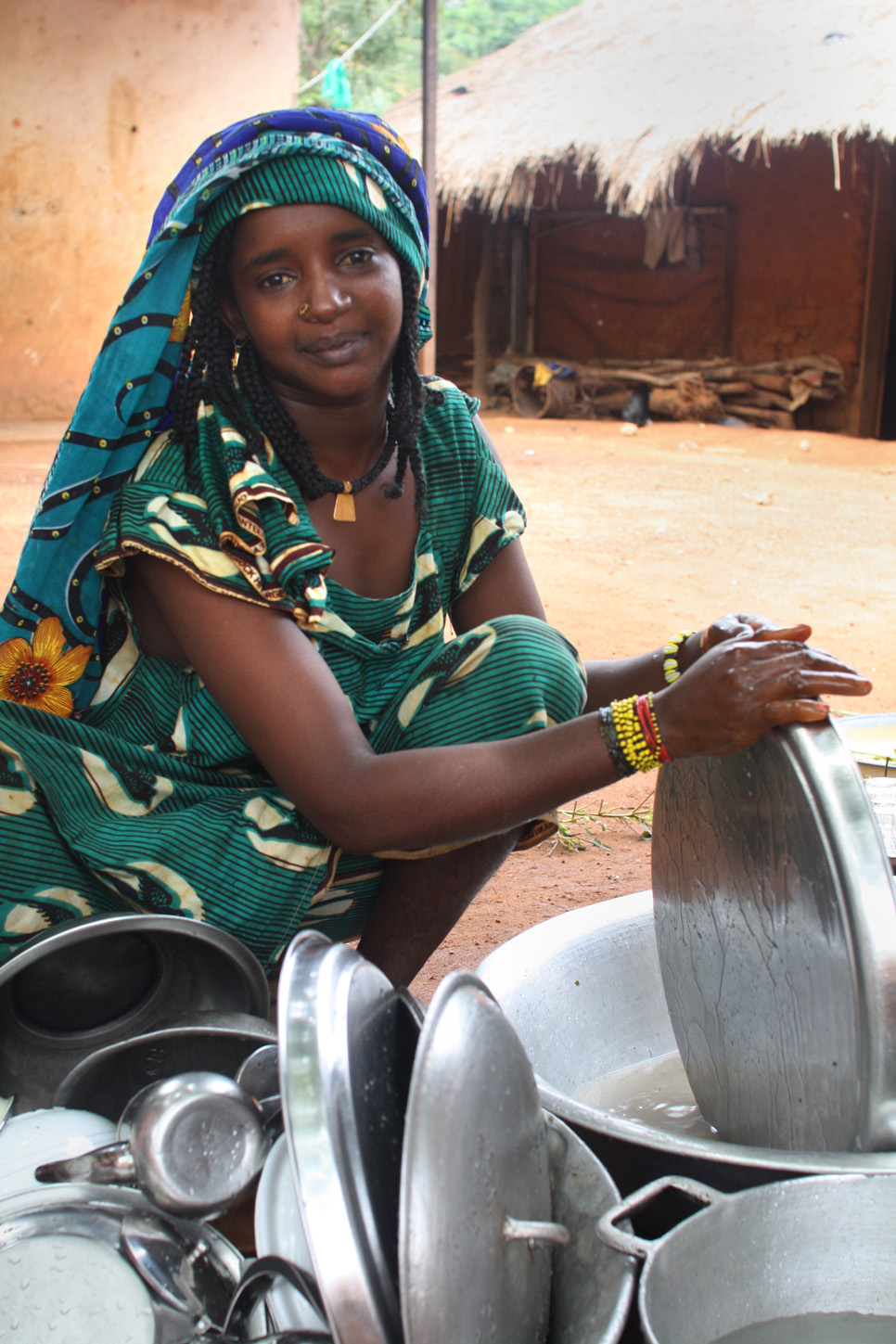
My first Saturday in Central Africa was spent in the rice fields at the Project Hope and Charité widow gardens. It was harvest time. I only knew a couple words in Sango then—greetings mainly. It seems fitting that my last Saturday was also spent in a rice field. This morning I went along with Wilfried to help one of his Fulani friends prepare his rice garden and to spend time with the women in the Fulani community near there. I have been to this community several times and have been building relationships with the women but I still only know a few words in the Fulfulde language—greetings. It proves a very humbling point that even after living in Central Africa for eight months my knowledge of the country is still miniscule.

So this morning I found myself back in a similar situation as I found myself in eight months ago: observing an African lifestyle I know very little about.

Here are a few pictures from my observings:
Ibrahim, his younger brother, and Wilfried working in the rice garden

washing dishes
doing laundry
I wasn't the only one doing observing


My first Saturday I spent harvesting rice that had been planted long before I arrived. I observed the Christian widows as they did what they do on Saturdays. Today I helped prepare a rice field that has yet to be planted and I observed Muslim women doing what they do on Saturdays. I am an observer and a learner taking part in only a small period of work. Many people have labored here before me and there is much work to be done after me. This is what I have learned from my first and last Saturdays of my internship in the Central African Republic.

Saturday, June 11, 2011

nôrməl

I think I’ve forgotten what is supposed to be normal. Normal? You ask. Yeah, you know… normal. That adjective that means “usual, typical, or expected.” nôrməl. Those things you do and see that seem so natural you don’t think twice about them. After 7 ½ months of living in Africa I think my standards of normal have shifted. Maybe. But who am I to say what is "usual, typical, or expected."

When I say normal I mean this:

  • Living at a mission station with a high fence around it and a guard at the gate.
  • Sleeping under a mosquito net.
  • Morning runs past the president’s palace, along the river where the sun is rising and over a crowded mountain trail full of goats and Africans headed to work.
  • Greeting everyone with a handshake and the subsequent questions of how they slept and how they and their family are doing.
  • Skirts. Everyday.
  • Sweatshirts and winter coats when the temperature drops below 80 degrees Fahrenheit.
  • Ants. Everywhere.
  • Sifting flour before cooking to get the bugs out.
  • Having fresh fruit and vegetables brought to the door every Monday, Wednesday, and Friday.
  • Hairdos that stick out all over.
  • Blaming upset stomachs on worms and parasites.
  • Squishing seven people (sometimes more) into a taxicab to get home from work.
  • Bartering.
  • Mangoes that cost 5 cents each.
  • Powdered milk in a can.
  • House help that does all the cleaning, laundry, and dishes three times a week.
  • No electricity between 5am and 9am, 3pm and 6pm, and sometimes between Wednesday and Friday… give or take a few hours.
  • Generator noise.
  • Soldiers standing around with machine guns slung over their shoulders.
  • Getting stared at for being white and staring at other people for the same reason.
  • Using filtered water from a bottle for teeth brushing.
  • No air-conditioning or TV.
  • Eating peanuts out of a whiskey bottle.
  • Palm trees, a mango tree, and a flowering plumeria tree outside my bedroom window.
  • Daily trips to the swimming pool at the US Ambassador’s house.
  • Potholes. Little boys standing beside potholes holding shovels and tin cups begging for money. And more potholes.
  • Words that begin with mb, ng, and nz.
  • Missionary parties that you have to bring your own food to and leave before 9pm.
  • Kids with ripped clothes and 17-year-old mothers with naked babies.
  • Ditches full of green slime.
  • Grapefruit soda in glass bottles.
  • Belgian Google.
  • Stories about pets accidentally getting killed for food and stories about annoying flights with extra long layovers at sketch hotels in Cameroon all because an African tried to catch a free ride in the wheel well of the plane and got crushed to death by retracting landing tires wrecking the chance of the plane's smooth landing.
This is Africa. This is my normal… at least for a dozen more days. I’m forgetting what United States normal is. Sometimes I go into my empty kitchen pantry and flip on the light to remind myself what used to be my normal. The light is the only light in my house that comes on the second you flip the switch. Sometimes I turn it on and off several times really fast for the pure novelty of it. It’s hard to believe that in a couple weeks I’ll be back in the land of instant light, clean kids, dogs with leashes, and boneless-skinless chickens with price tags on them. Normal? The more I think about it, the less I know what normal is. 

Wednesday, June 8, 2011

Soccer, Soldiers, and I Shook the hand of the President

Sunday. 5 June. A day for being proud to be a Central African.
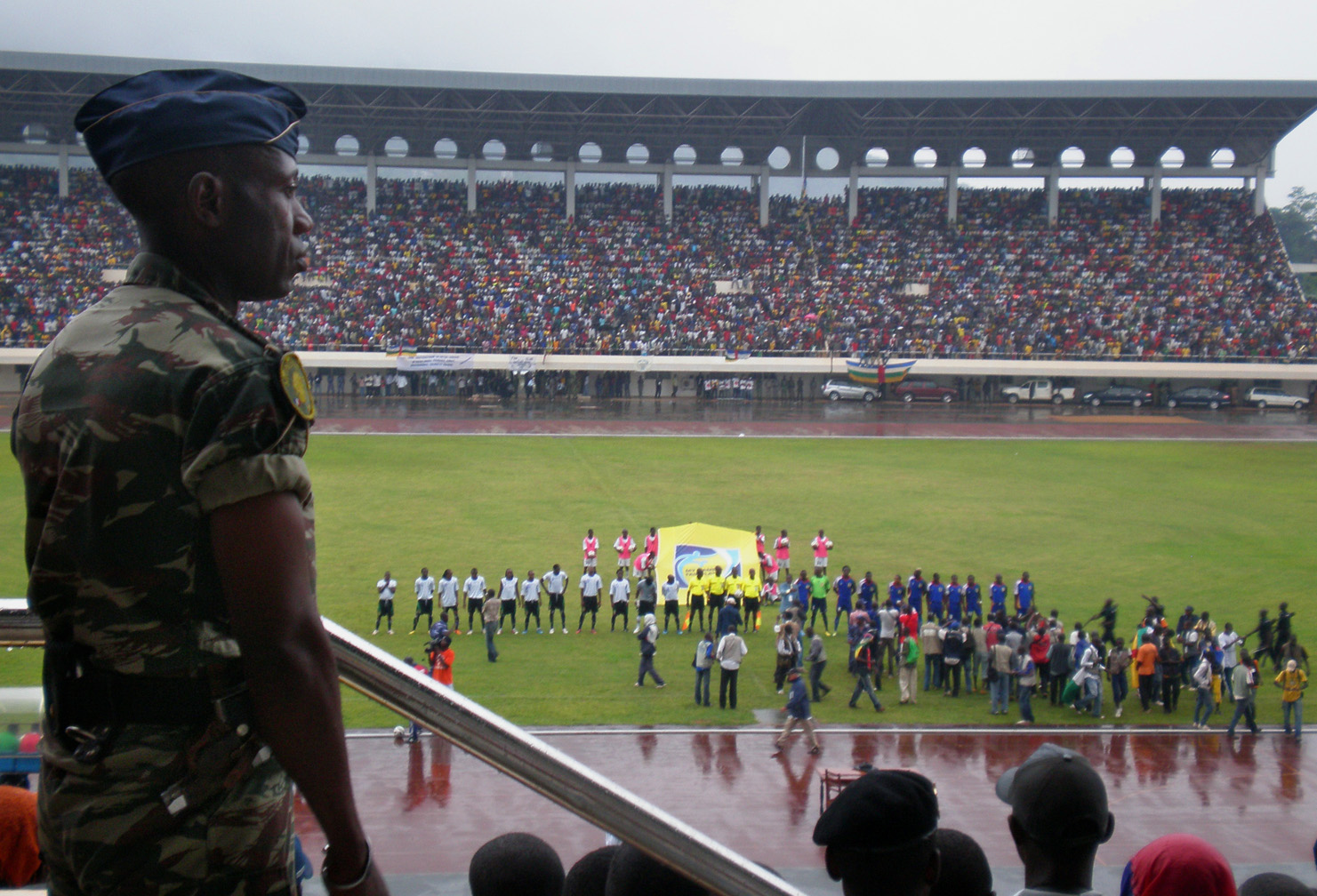
Starting early in the morning I could hear vuvuzelas and see Central African flags parading down the street towards the crowded Barthélémy Boganda Stadium. Why? Sunday was the third round qualifying soccer match between the Central African Republic and Tanzania for the African Nations Cup. It was a pretty big deal because Central Africa has previously competed in this tournament, well… um… never.
Pre-game: Tanzania in white, CAR in blue
Central Africa, currently 113th in the FIFA world rankings, pulled off a 2-1 win over Tanzania. They deserved it because they played well (even if it wasn’t all completely fair... not counting Tanzania's second goal was payback for getting unfairly beat by Tanzania in March I guess. Apparently playing on your home field with your own refs makes all the difference when it comes to winning matches between these two countries.)

Being at the game with thousands of Central African fans watching soccer was exciting enough but my serendipity of the day was sitting in the same row as President Bozize and getting to shake his hand. I can now check that off the list of things I need to do before heading home.

With high profile people attending the packed out game and recent unrest in Bangui, the military presence was anything but inconspicuous. The minute the final whistle blew, a crowd of camouflage-clad military men and women carrying big guns stormed onto the field.
Post game: Central African military lining the perimeter of the field

Victorious, proud, and well behaved. That’s how I’d describe Central Africa on the evening of June 5. I’m pretty sure that regardless of the various facial expressions (jubilant faces of fans, angry face of man getting shoved in a crowd, stern faces of soldiers, emotionless face of the president) every Central African in the Barthélémy Boganda Stadium was proud to be Central African.

Tuesday, May 31, 2011

Where's the pineapple?

ananas in my front yard

Ananas. Better known to English speakers as pineapple: an exotic, tropical, and sweet fruit with a strange name. Seriously though, what kind of a name is pineapple anyway? Maybe you don’t care to know but sometime in the 17th century someone decided the ananas fruit looked like a pinecone. Except it's better than a pinecone, of course, because of the fact that its insides are full of yellow sugary edible goodness. That is probably where the apple part of the name comes into play. That strange yellow fruit looks like a pinecone but, if you’re into comparing things, tastes more like an apple than a pinecone. Or maybe the apple part was attached because the big edible pinecone became so treasured as a scrumptious fruit that it was called the apple of one’s eye. I personally like to call the tropical goodness ananas—that name brings better results when I go to the market searching for the funny looking pinecone fruit.

ananas on a taxi
One of the great things about living in the tropics is that I get to eat ananas all the time… some days I eat ananas for every single meal and snacks too. I love ananas. Ta tene. That’s the truth. So does Shawn Spencer. I’m not alone in my ananas love. Here in Central Africa ananas are everywhere you turn. They are hanging up along the side of the road, stacked in piles on street corners, on top of women’s heads, painted on taxis, incorporated into logos, printed on cloth, cross-stiched on bags and tablecloths, carved into beds, fashioned out of wood and sold at the artisan market… you get the point.

pineapple upsidedown cake
A couple weeks ago I had some different groups of the PHC kids make welcome signs to hang in our office for when Barb, the state-side director of PHC and my boss, arrived back in Africa for her three week visit. As I hung all the lovely welcome-back pictures for Barb on the wall I was delighted to discover that every single picture included an ananas. That’s a lot of pictures with ananas—too many to be simply coincidence. It could be all the kids think ananas are Barb’s favorite fruit. I don’t know the answer to this but I was curious as to why everyone around here is so obsessed with ananas so I did what anyone would do when they are curious and need answers: I turned to google and wiki answers. It turns out that the ananas is an international symbol of hospitality and associated with welcoming guests, safe travels, warmth, and friendliness (you can do your own google search and read the history on your own). Apparently these orphans are much more educated in the language of international symbols than I am and apparently the city of Bangui is trying to be really welcoming, warm, and friendly because there sure is an abundance of ananas.


ananas in a village hung on the edge of the road being sold for 40 cents each