Tuesday, May 31, 2011

Where's the pineapple?

ananas in my front yard

Ananas. Better known to English speakers as pineapple: an exotic, tropical, and sweet fruit with a strange name. Seriously though, what kind of a name is pineapple anyway? Maybe you don’t care to know but sometime in the 17th century someone decided the ananas fruit looked like a pinecone. Except it's better than a pinecone, of course, because of the fact that its insides are full of yellow sugary edible goodness. That is probably where the apple part of the name comes into play. That strange yellow fruit looks like a pinecone but, if you’re into comparing things, tastes more like an apple than a pinecone. Or maybe the apple part was attached because the big edible pinecone became so treasured as a scrumptious fruit that it was called the apple of one’s eye. I personally like to call the tropical goodness ananas—that name brings better results when I go to the market searching for the funny looking pinecone fruit.

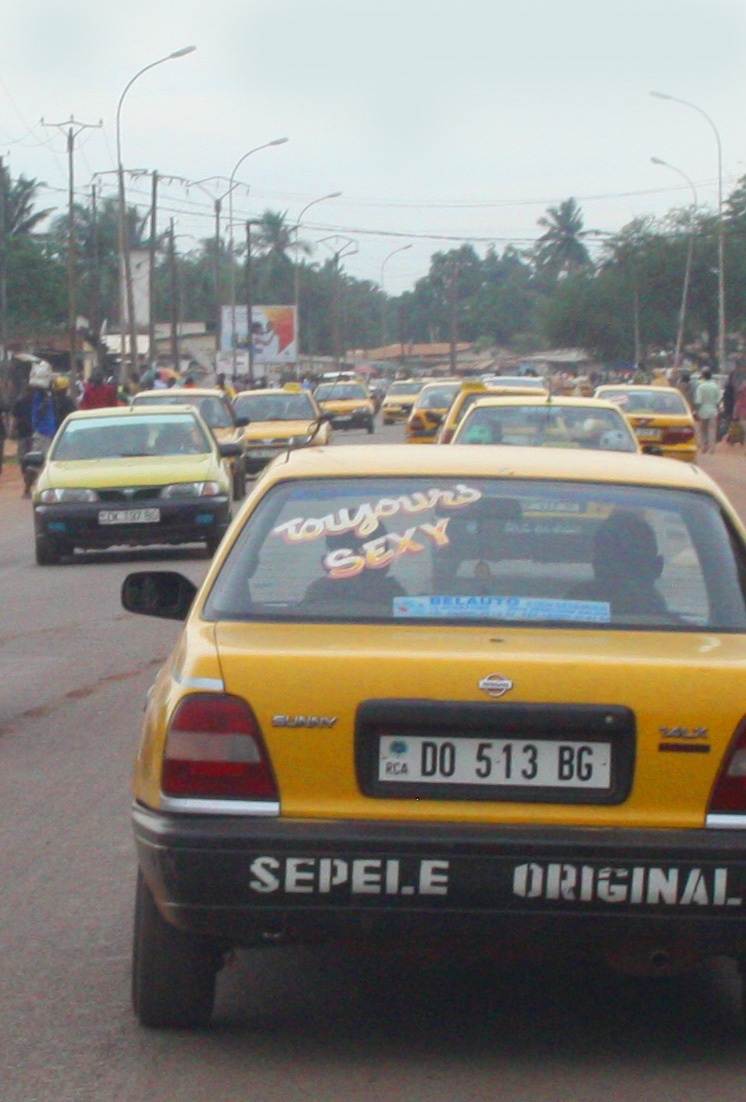
ananas on a taxi
One of the great things about living in the tropics is that I get to eat ananas all the time… some days I eat ananas for every single meal and snacks too. I love ananas. Ta tene. That’s the truth. So does Shawn Spencer. I’m not alone in my ananas love. Here in Central Africa ananas are everywhere you turn. They are hanging up along the side of the road, stacked in piles on street corners, on top of women’s heads, painted on taxis, incorporated into logos, printed on cloth, cross-stiched on bags and tablecloths, carved into beds, fashioned out of wood and sold at the artisan market… you get the point.

pineapple upsidedown cake
A couple weeks ago I had some different groups of the PHC kids make welcome signs to hang in our office for when Barb, the state-side director of PHC and my boss, arrived back in Africa for her three week visit. As I hung all the lovely welcome-back pictures for Barb on the wall I was delighted to discover that every single picture included an ananas. That’s a lot of pictures with ananas—too many to be simply coincidence. It could be all the kids think ananas are Barb’s favorite fruit. I don’t know the answer to this but I was curious as to why everyone around here is so obsessed with ananas so I did what anyone would do when they are curious and need answers: I turned to google and wiki answers. It turns out that the ananas is an international symbol of hospitality and associated with welcoming guests, safe travels, warmth, and friendliness (you can do your own google search and read the history on your own). Apparently these orphans are much more educated in the language of international symbols than I am and apparently the city of Bangui is trying to be really welcoming, warm, and friendly because there sure is an abundance of ananas.


ananas in a village hung on the edge of the road being sold for 40 cents each

Thursday, May 26, 2011

Celebrations and Collectivism

Africans live for celebrations: national holidays, weddings, baptisms, inaugurations, graduations and even funerals. They are something to look forward to, something to mark accomplishments or hopes, a reason to gather. In a collective society celebrations bring meaning to life. Life is lived together, plans are made together, dreams are dreamed together and life, from beginning to end, is celebrated together.

a Ba'Aka pygmy graduate
Celebrations aren’t taken lightly. People travel long distances, give long speeches, sing, dance, and eat a lot of food. The men wear suits, the women put on wigs, and the children wear shoes. When it comes to celebrating there seems to be an unspoken rule that if a little is good, a lot is better. Lots of people, lots of food, lots of talking, lots of singing, lots of celebrating… which logically equals lots of meaning to life. (This might explain why there seems to be an overabundance of national holidays.)

This week I have had the honor of taking part in two celebrations. The first was a groundbreaking ceremony for a new learning center at the Grace Brethren Seminary and the other was a graduation ceremony at the Mbaiki Bible Institute. Both events held a lot of significance for those involved.
the dedication stone at the site of the new building
Grace Brethren pastors from all parts of Central Africa and from the United States gathered together to celebrate the dedication of the new building project at the James Gribble Leadership Training Center (the Grace Brethren seminary). The leaders of the seminary and missionaries have been dreaming and planning together and this celebration marked an important step forward in reaching their goal of equipping Central African leaders for ministry. It was a somewhat serious sort of celebration including prayer and talks to remind those gathered of the vision and perseverance it takes to accomplish the work God has called them to but a celebration none-the-less. 

Barb with the pygmy graduates
The Mbaiki Bible Institute graduation was a more light-hearted celebration. It was particularly significant because there were seven pygmy couples who graduated this year meaning that when combined with the pygmy graduates from the other Bible institutes, the number of Bible Institute trained pygmy pastors is nearly tripled. For these pygmy couples and the other couples graduating it was a celebration of the end of three years of study and the beginning of a life of leading, teaching, and ministering among their tribes. The graduation involved much more dancing and music than any of my graduations ever did! One of the most fascinating parts of the graduation was when, after walking (or dancing) up to receive their diploma, the graduates would walk over to their spiritual mentor and hand over their diploma and awards. It was a way of saying, “Thank you for dreaming dreams with me and for helping me accomplish what I have today. I want to honor you because you have helped me become who I am.”
lots of people at the Mbaiki church

In Central Africa life is lived as a group and life is celebrated as a group from beginning to end. People pray together, dream together, and learn together. Like anything involving people, this way of life has its flaws but this past week I saw the beauty of what it means to be part of a collective society. 

Wednesday, May 18, 2011

MBETIMANGUE Elisabeth

Classroom number one, bottom floor, first on the left. Five days a week this classroom is filled with 63 tiny first grade orphans and one courageous teachers. Currently finishing up her first year of teaching at Project Hope and Charité, Elisabeth is by no means new to being a teacher. Elisabeth has wanted to be a teacher since she was the age of her first grade students and she has been living out her dream for the past 29 years teaching in many different schools around Bangui. Her mother was illiterate but Elisabeth said her father was a teacher by occupation and he did a good job of making sure his children were educated, most importantly in the Word of God.
When I asked the small spunky women what her favorite subject to teach was she promptly told me it was teaching about God. “I have been teaching kids and adults of all ages the word of God at church and in schools, private and government alike,” Elisabeth told me, “I like to teach little kids better than grown-ups, though. Grown-ups are not so excited to learn but little kids’ hearts want to learn and believe. I get so much joy when I see that my students are understanding what I’m teaching them and growing in the Lord.” Elisabeth was teaching addition the day I sat in on her class. As Elisabeth taught, the little kids were busy chalking numbers onto their small slates and adding them up. I’m not sure how she kept the attention of that many little kids.
Elisabeth’s motivation for teaching is a desire to be a role model. She loves to learn, read, and study the Bible and she wants to inspire kids to be excited about learning too.
She is very proud of her class of 63 PHC first graders. They have been doing excellent this year, I’ve been informed, and are receiving very good grades. Elisabeth, who is quick to smile and not afraid to be stern, has done a great job teaching her overflowing class of first graders! Project Hope and Charité is fortunate to have a teacher as good as Elisabeth.
Elisabeth with her 1st grade class

Friday, May 6, 2011

Central African People: LAOUKOURA Jeremie

Oh the places you go, the people you meet, the dreams you encounter… here in Central Africa I am surrounded by people with fascinating life stories and dreams. I have decided I need to practice my interviewing/journalism skills and start introducing you to some of the cool people you might encounter if you’re ever in Central Africa.

So without further to-do, meet LAOUKOURA Jeremie. 

I met Jeremie a couple weeks ago while I was at the James Gribble Leadership Center (the Grace Brethren seminary here in Bangui) doing some research and interviews. He is a first year student who comes from a family of pastors: both his grandfather and father were preachers in Powa and his younger brother, Jean Paul, is a pastor now too.
Even though neither his grandfather nor father received seminary degrees, Jeremie accredits them with teaching him the ways of ministry and he says they were the ones who encouraged him to pursue seminary. Jeremie, however, is not going to seminary in hopes of one day becoming a pastor. His dreams are a little different from his forefathers although the goal is very similar. Jeremie’s dream is to translate the Bible into Kaba, the language of his home village of Powa.

Powa, sometimes spelled Paoua, is located in northern Central Africa in an area that is currently war-torn and unstable due to rebel activity. Many people have been driven out of the village or have fled for safety, Jeremie and his family included. In the capital city of Bangui Jeremie has been employed by SIL, better known as Wycliffe Bible Translators. He has helped with various translation projects but at this point the project of translating the Bible into Kaba is still only a dream as far as I could gather. It is an important dream to Jeremie because, as he explained, not everyone in his hometown knows the trade language of Sango, especially not the women. “I want the people of my village to understand the Bible in their own language and understand it well. If they can hear the Bible in their native language it will speak to their hearts in a way a non-native language can’t,” Jeremie commented.

Jeremie with fellow seminary students
Jeremie has put his translating work on hold while he receives seminary training at the James Gribble Leadership Training Center. He is taking courses in Greek and Hebrew, both languages he needs to know in order to accurately translate the Bible. He is on the right track for reaching his goals but it’s already been a long journey. He began his undergraduate level Bible training in 1982, fell sick, had to go to Cameroon for treatment, and wasn’t able to finish until 1999. (His wife, however, was able to finish a Bible degree during this time, which I think is pretty cool). Since 1999 he has worked with his father in the church he was leading in Powa, he has done translating work, and served in other churches doing his best to support his wife, three sons, and three daughters.

Almost one year of seminary done and two to go. You can pray that Jeremie continues to have the dedication, strength, and health to accomplish his dream of translating the Bible into Kaba. He still has a long road ahead of him.

Saturday, April 30, 2011

Red Tables + Jewelry Making + African Orphans

It’s an interesting combination. Here’s another interesting combination: fair + trade. The motivation behind the jewelry making + African orphans is to begin a micro enterprise sort of thing with a few of the students at Project Hope and Charité so that they can learn a skill and generate some income. The words fair + trade have a couple definitions, “trade carried on legally” or “trade in which fair prices are paid to producers in developing countries.” I can’t vouch for the first one being true but the second definition is the goal of this whole operation.

I have been the middleman between my African co-worker Stephane and the Fair Trade Consultant Team (that’s what I’m calling them) in the States. It’s been an interesting process. After weeks of international skype meetings + emails + trips to the market, today was the day that things finally got rolling. The red tables are where it's all happening.

Here are some pictures from the first training day with the kids and one last interesting combination for you: banana leaves + glue + gloss + fishing line.


Stephane doing some demonstrating
cutting the banana leaf into strips

rolling up a banana leaf to make a bead
applying the glue and gloss
stringing the beads
coming soon to a fair trade store near you!

Wednesday, April 20, 2011

How to evaluate a Taxi

I don’t have a car in Bangui. I don’t mind. The process of getting from one place to another is more interesting when you don’t have a car. I ride around in taxis a lot since it’s a 10-kilometer distance to get to the orphan center.
The past few weeks I’ve gone “under cover” interviewing taxi drivers and critiquing their taxis trying to find a good reliable ride to work.
What are the criteria for a “good” taxi? This can be tricky. My taxi evaluation checklist changes depending on the day and the type of experience I want. However, there are a few basic things you should know to look for when evaluating a taxi.

Inspecting the vehicle:
  1. Does the Taxi have four wheels? If a taxi has four wheels it’s in business. For a lot of people the evaluation ends here… I’m a bit more demanding.
  2. Can you get in and out of the car? It’s usually a bad sign when you have to reach through the window to open up the taxi door from the inside. However, it’s even worse when you can’t get out and have to reach out the window to open the door. To avoid potentially getting trapped in a taxi with a taxi driver you don’t know (and to avoid the embarrassment of pulling of the handle to a door that won’t open from the outside) I recommend always reaching through the window and opening the door from the inside upon entering a taxi.
  3. Can you see out the windshield? Ideally the windshield should be free of cracks but that is very idealistic. I’m ok with settling for a taxi with a windshield you can see out of and doesn’t look like it will break in a million pieces the next time the wind blows.
  4. Does the taxi function properly? Meaning, does the car sound “healthy” or are there lots of crazy noises coming from all over the car making it seem like the car may break in half or the engine blow up at any moment? Pay attention, some taxi drivers are quite clever and try to cover up the “unhealthy” car noises with loud music. Don’t let yourself be fooled!
Interviewing the driver:
  1. You can tell a lot about a taxi driver by what’s painted on his car and pasted to the windows. Paying attention to these things will give you a good preliminary assessment of the driver. For example, if there’s a Bible verse on the bumper you know he is at least a little bit religious; enough to think that a Bible verse could protect his car. If, however, there are words like sexy, hott baby, or cutie sprawled across the back window you can assume the diver will tend to be a bit egocentric. Other things you might see once inside the car include, but are not limited to: McDonalds happy meal toys, images of Miley Cyrus and Chris Brown, and Chinese good luck charms… interpret accordingly.
  2. Ask questions about anything and everything. If you are going to be putting your life in the hands of a chauffeur, you have the right to know everything about him. These questions may lead to in-depth conversations about family, politics, or culture and may even lead to photo albums. If, during this stage of the interview process, the driver appears particularly distracted from the task at hand (getting you safely from point A to point B) they have failed.
  3. If the taxi driver asks you to marry him at any point during the trip cross him off your list immediately. (Unless of course you are looking for a Central African husband in which case you will need to move on to a more focused evaluation. I’m sure there are a lot of perks to marrying a taxi driver including having a personal chauffeur and a husband who earns money.)
  4. Quiet taxi drivers who don’t like to talk much can be good. However, before filing his phone number with your list of reliable taxi drivers be sure you can understand him when he does talk. Calling a taxi driver you can’t communicate effectively with is more frustration than it’s worth and rarely works out.
  5. The last part of the interview is testing the taxi driver’s integrity. This happens when you pay them. I’ve found it is best just to give them the going rate. If they demand more do as you please but cross them off the list. No one likes a taxi driver who tries to overcharge.

Two taxi drivers so far have successfully made it through my evaluations. One, a spunky driver named Africain, made it past the interview and vehicle inspection (there were no cracks at all on his windshield!) but failed in the follow-up after he tried calling me Monday at 6:30am. Taxi drivers who interfere with your sleep are not acceptable. That leaves one. He seems quite promising.

Wednesday, April 6, 2011

a long blog post without any pictures of cute African kids

7:00am—It’s one of those rare overcast mornings. Ellen is out of town so I’m not going for my typical early morning run (I’m not allowed to go running in Bangui by myself) and PHC is on vacation so I don’t have to go out to the center to work. I turn off my alarm and fall back to sleep.

7:45am—Oops! I jolt awake realizing there are probably already at least two people waiting at my door for me to wake up.
I quickly pull on my below-the-knee length skirt and go unlock the door for Giselle, our house help. A few minutes later Odette is sitting on my porch announcing her arrival, “Amy! Mbi ga awe!” Odette comes every Monday, Wednesday, and Friday selling fresh fruits and vegetables. “Mo lango nzoni?” she asks. Did you sleep well? Yep and I’m still half asleep. Thanks for asking.

I eat my breakfast of mango sauce, the African version of apple sauce, along with my daily dose of malaria medication and by 8:30am I’m in the office taking care of emails and odds and ends for work.

9:30am—Isaac, our day guard, comes into the office to inform Caitlin and me that we have visitors. Visitors? Who? My mind is still not in Sango mode. From his explanation all I gather is someone named Tambe, kids from Project Hope and Charité, and someone died. This doesn’t sound good! I quickly check the PHC student master list on my computer trying to figure out which of the over 1000 PHC kids might be coming to visit or possibly be dead. It is mango season after all and there have been a lot of deaths recently due to people falling out of mango trees (but no PHC kids that I’ve heard of).

I go outside to greet the visitor, praying that nobody has died. It’s a PHC girl who has been asking to come over to my house for weeks. In general I try to avoid letting anyone who asks come hang out at my house. That would get really crazy really quickly! The thing about Africans, though, is that they are persistent and don’t like taking no for an answer. “Mbi ga to sala kwa-ti-li ti mo,” the girl with the last name Tambe told me. She came to do my hair. I’m very relieved that no PHC kid had died. Apparently Isaac was trying to tell us our visitor was the daughter of a Grace Brethren pastor who had died and she’s a PHC orphan. I guess I’m not used to people getting introduced by who their dead father was.

9:45am— Despite being slightly annoyed at the interruption in the middle of my work by this persistent little 6th grader and the cousin she brought along, I quickly finished up my emails and go to get my hair done. I sit in my living room in front of Oulda Tambe for the next hour getting my hair braided up while Giselle mops floors and dusts around us quietly humming African hymns.

11:45am—Oulda is almost done braiding Caitlin’s head now. Giselle is finishing up our laundry. Oulda’s cousin, Ornella, is eating peanuts out of a Scotch whisky bottle and I am sitting here with them with a head full of braids pretending to do work but actually writing a blog that I will upload later when I have internet.

Noon—They’ve finished Caitlin’s head and have now informed us that they don’t have anything to do this afternoon so they’re just going to sit in our house if that’s ok. Um… no it’s really not ok. A few minutes of awkward silence and peanut munching. Caitlin and I have work. How do you politely tell Africans who invited themselves over that they need to leave?

12:18—They finally got the hint. Well not exactly. We tell them we have to go back to work in our office. “A yeke sengue si i gwe na mo ti douti kete na bureau?” No you can’t come with us to sit in the office. You need to go home. We can’t go home. Our house is far away and we have no money they say. How did you get here? They come without asking and won’t leave until they get money for a bus home. Oh and hey… while they’re at it… “I have a ceremony at church on Saturday and I wanted to ask you if you can buy me new clothes. I don’t have any nice clothes to wear,” Oulda informs me. “Pardon, mbi lingbi ti vo fini bongo ti mo ape.” Seriously? No I am not going to buy you new clothes!!! If I bought clothes for every PHC girl who asked me I'd be broke in no time! We pay for their bus ride home.

12:20—I’m sitting in the corner of the finance office that belongs to Caitlin at the moment. It’s closed today. Isaac is back. He informs Caitlin that Gabin is here to talk to her. NO!!! She rolls her eyes. Be sure to tell him he can’t get money today she tells Isaac before he sends Gabin in to “talk.”

12:27—Gabin is leaving the office (with money). Persistent. That’s what these Central Africans are.

12:45—I think I've worked enough for one morning. Giselle is finished with cleaning our house and washing our clothes and dishes. I’m hungry. Maybe I’ll go back home, lock the door, and eat some mango pie. Hopefully nobody else comes to visit because that would mean I’d have to share my mango pie.